GitHub Actions Workflows for AI-Generated Repositories
Agentic Workflows add security guardrails to AI coding agents in GitHub Actions.
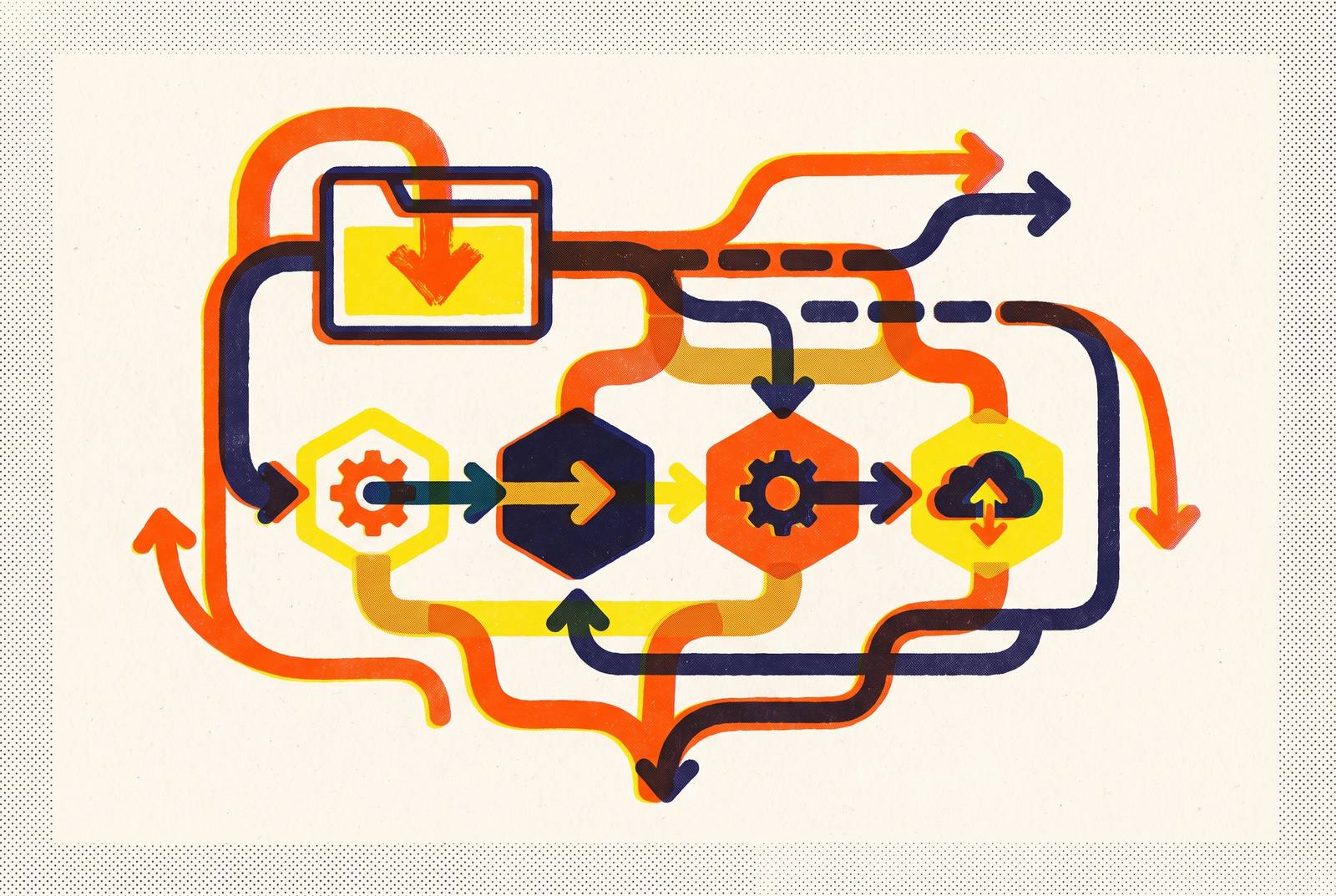
GitHub's Octoverse 2025 report counted over 4.3 million AI-related repositories on the platform, a 178% jump year over year in LLM-focused projects. More than half of all code committed now is written or assisted by AI, and 61% of teams say testing demand has gone up moderately or dramatically because of it. That growth doesn't fit inside the workflow model GitHub Actions was built for, one that assumes known code paths, enumerable edge cases, and commits arriving at a human pace. What follows is the architecture GitHub has been building to close that gap, and how teams running AI-generated repositories should actually put it together.
GitHub's Copilot Coding Agent and the baseline before Agentic Workflows arrived
Copilot Coding Agent shipped in May 2025 and changed something basic about where an AI agent lives during development. Instead of a developer running an agent on their own machine, GitHub Actions runs it for them, kicked off by an issue, a PR comment, or a schedule. The loop it set up was simple to describe: the agent reads the codebase, writes code, runs the test suite, opens a pull request, and a human reviews and merges it.
That loop worked, but it exposed a hard limitation. Calling Copilot directly from a workflow YAML step meant handing it full write access to the repo, with no additional guardrails sitting between the agent and the code. It ran fine in practice, but the architecture was fragile: it worked until someone found the edge it wasn't built for.
GitHub had already shown it's willing to walk away from approaches that don't hold up. Copilot Workspace, an earlier experiment along similar lines, had its technical preview sunset on May 30, 2025. A company retiring its own prior bet on agent tooling because a better model was already in motion behind it stands on its own.
What GitHub Agentic Workflows are and how they execute
Agentic Workflows entered technical preview on February 13, 2026, and moved to public preview on June 11, 2026, broadening access beyond the earlier technical preview. The project came out of a joint effort between GitHub Next, Microsoft Research, and Azure Core Upstream, built around one question: what does repository automation look like once you add real guardrails on top of an AI coding agent.
The file format is the clearest sign of what changed. A workflow is a Markdown file with YAML frontmatter. The frontmatter sets the trigger, the permissions, the tools, and which AI engine runs the job. The body of the file, written in plain Markdown, states in natural language what the agent is supposed to do. That's a genuinely different way to author a CI job: half config, half instructions a person could read and understand without knowing YAML syntax.
Before any of it runs, a compilation step called gh aw compile validates the source file and produces a .lock.yml file, which is what GitHub Actions actually executes. That distinction matters. This isn't a prompt fired off at runtime and hoped for the best, it's compiled, checked, and version-controlled like any other workflow file in the repo.
The security architecture that makes Agentic Workflows usable in production
Agentic Workflows default to read-only access. Any write operation, whether that's opening a PR, adding a label, or posting a comment, has to go through a pre-approved set of "safe outputs" rather than the agent getting raw write permissions to do whatever it decides. Network access is isolated and restricted to an allowlist of tools, and dependencies are pinned by a fixed version identifier so a supply chain surprise can't slip in through a tag that quietly points somewhere new.
Set that against the naive version of the same idea: an AI model called directly inside a YAML step, holding full repo write access, with no sandbox around it. That's the structural risk that Agentic Workflows was designed to close off.
The platform-level controls released alongside this reinforce the same posture. Action allowlisting, which lets a team define exactly which actions and reusable workflows are permitted to run, used to be an Enterprise-only feature and is now available on Free, Team, and Enterprise plans alike. Bot-created PR approvals closed a separate gap: pull requests opened by github-actions[bot] can now trigger CI/CD, but only once a user with write access approves them, which stops a bot PR from getting merged without ever running the test suite.
Workflow execution protections are now generally available across GitHub Enterprise, organizations, and repositories, giving teams actor rules (who is allowed to trigger a run) and event rules (which events are allowed to start one). A disallowed run doesn't get silently skipped, it fails with an error, which is the right default for anything touching production. And starting November 2, 2026, pull_request_target will be disabled by default on public repositories that don't have an applicable event policy set, specifically to block pipeline poisoning attacks launched from forks.
Real-world prompt injection attacks that have already hit agentic CI pipelines
Calling Copilot directly from a workflow YAML step, while it holds elevated privileges and reads untrusted content such as issue titles, PR descriptions, and code comments, produces a structural vulnerability, as the pipeline's own configured secrets and write access make clear. An agentic workflow reads untrusted content, issue titles, PR descriptions, code comments, while holding elevated privileges: write access, and often secrets configured into the pipeline itself. That means the agent's context window doubles as an attack surface. Anything a stranger can type into an issue is something the agent might read and act on.
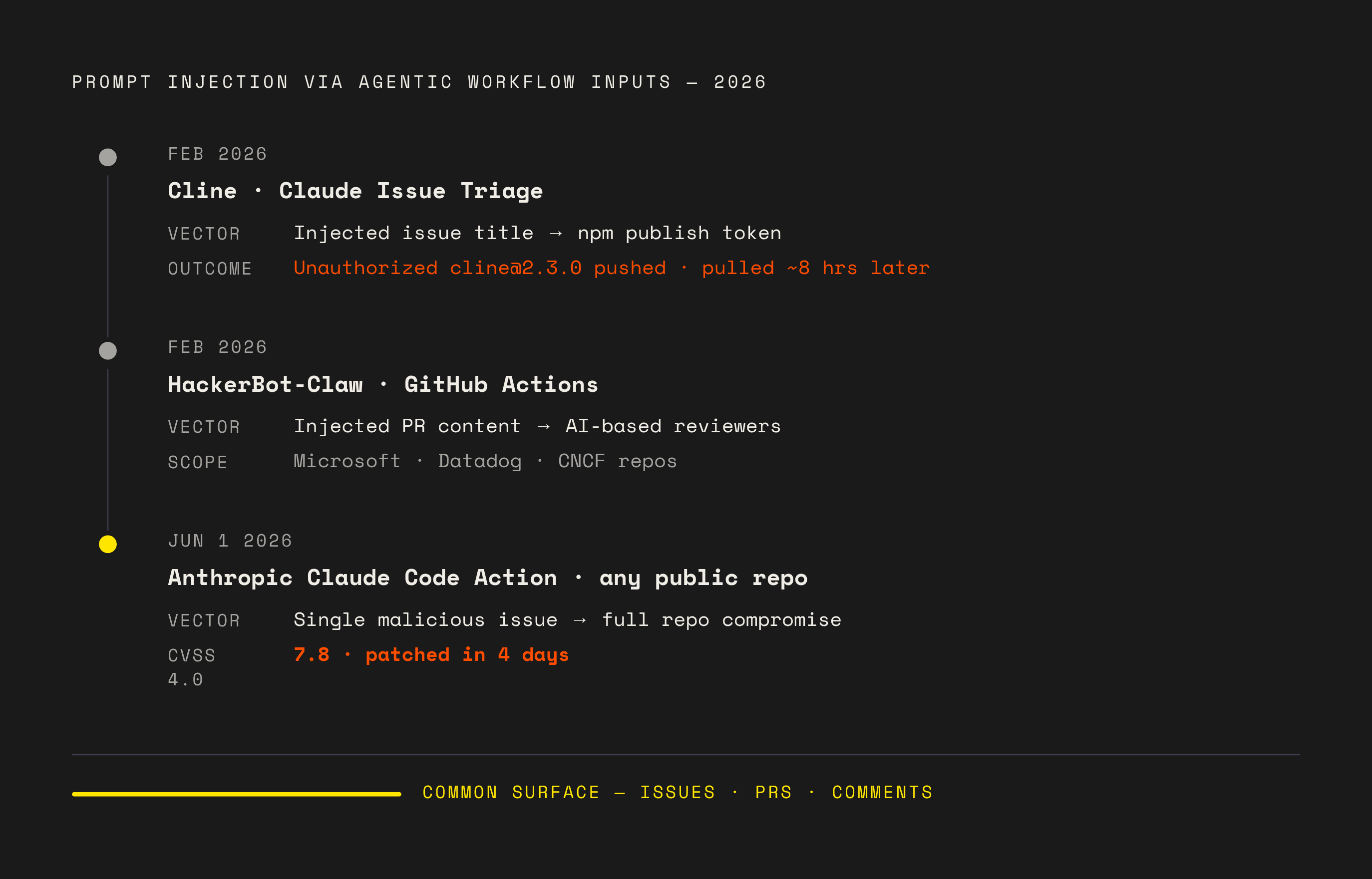
Three incidents already show what that looks like in practice. In February 2026, a prompt-injected issue title against Cline's Claude Issue Triage workflow let attackers steal an npm publish token and push an unauthorized cline@2.3.0 release. The rogue package force-installed a separate, non-malicious AI agent, and the release was pulled roughly eight hours later, but the token theft had already happened by then.
Later that same month, a campaign referred to as HackerBot-Claw probed GitHub Actions misconfigurations at Microsoft, Datadog, and CNCF projects. The campaign probed GitHub Actions misconfigurations and attempted prompt injection against AI-based reviewers, illustrating how agentic pipelines can become direct targets for adversarial manipulation.
Then on June 1, 2026, RyotaK of GMO Flatt Security published a writeup showing that a single malicious GitHub issue could compromise any public repository running Anthropic's Claude Code Action. Anthropic had patched the flaw within four days of the private disclosure back in January, and the issue was rated 7.8 on the CVSS v4.0 scale. The pattern of agentic tooling carrying meaningful advisory counts is visible across several prominent repositories in the space.
The pattern across all three incidents is the same: the exact features that make an agentic workflow useful in an AI-generated repo, reading issues, parsing PR text, acting on comments, are the same surfaces an attacker will aim for. Design around that assumption rather than around the hope that it won't happen.
Six continuous automation patterns that pair deterministic and agentic workflows
GitHub Next laid out six "continuous automation" patterns alongside the Agentic Workflows announcement, and each one maps to a specific hole in conventional CI/CD that deterministic YAML was never going to fill on its own.
Continuous triage auto-labels and routes new issues as they come in, which matters directly for AI-generated repos where issue volume tends to scale with commit velocity. Franck Nijhof of the Home Assistant project is already running this pattern against a backlog running into the thousands of open issues. Continuous documentation keeps READMEs in step with code changes, which matters because AI-generated code tends to drift from its own documentation faster than a human maintainer can track by hand.
Triggered manually or on a schedule, continuous code simplification refactors and opens PRs for cleanup, and pairs naturally with the non-deterministic patterns AI generation tends to leave behind in a codebase. Continuous test improvement assesses coverage and adds tests where they're actually worth adding, which speaks straight to that 61% of teams reporting rising testing demand. Continuous quality hygiene investigates CI failures and proposes targeted fixes, the reasoning layer a deterministic test runner was never built to provide. Continuous reporting rounds it out by generating repository health reports, giving maintainers a running view of what all this agentic and AI-generated activity is doing to the codebase over time.
Peli's Agent Factory is a starting library here: a community collection of more than 50 specialized agentic workflows spanning ChatOps, DailyOps, DataOps, IssueOps, ProjectOps, MultiRepoOps, and orchestration patterns. The sequencing advice from GitHub's own materials is consistent: start with low-risk outputs, comments, drafts, reports, before turning on anything that can open a PR, and aim the first workflows at goal-oriented improvements rather than new feature work. None of this replaces the deterministic layer. Builds, tests, and deploys stay on conventional Actions; agentic workflows sit on top, handling judgment calls the YAML underneath was never built to make.
Third-party AI Actions on the Marketplace that extend the workflow stack
Four other options on the Marketplace stand alongside GitHub's own Agentic Workflows. AI GitHub Action, powered by OpenAI's Agents framework, handles automated PR reviews with auto-approval for high-quality contributions, issue analysis with categorization and prioritization, and code scanning for security vulnerabilities. Amazon Q Developer integrates with GitHub to support code review and development tasks straight from issues and pull requests, through its own integration model.
Claude Code integrates directly into CI pipelines through GitHub Actions from Anthropic, and the Cline incident above is a useful reminder here: a direct Claude Code Action integration needs the same prompt-injection defenses as a native Agentic Workflow, not fewer, just because it comes from a different vendor. AI YAML generators like Workik take a different angle entirely, generating GitHub Actions YAML for CI/CD pipelines, Docker, Kubernetes, and multi-cloud deployment across AWS, Azure, and GCP, along with dependency caching and conditional rollback logic, useful for teams that need to stand up workflow infrastructure quickly around a fast-growing AI-generated codebase.
Native Agentic Workflows enforce a compiled.lock.yml security model by design. A team choosing a Marketplace Action for AI automation should assess how much of that security responsibility it is taking on itself, and treat that as a deliberate decision, not a detail discovered after the fact.
Infrastructure decisions that affect how agentic workflows scale and perform
Runner infrastructure is the part of this stack that's easy to overlook until an agentic workflow queues up more jobs than the fleet can absorb. GitHub Actions Runner Scale Set Client entered public preview on February 5, 2026, a standalone Go module for building custom autoscaling setups without Kubernetes as a hard requirement. It talks to the same scale set APIs that back Actions Runner Controller (ARC), but leaves provisioning entirely in the team's hands rather than assuming a Kubernetes cluster is sitting underneath it.
That makes it platform-agnostic in a real sense: containers, VMs, or bare metal, across Windows, Linux, and macOS. ARC is still the right call for teams already running on Kubernetes, but the Scale Set Client fills the gap for anyone on VMs, bare metal, or a cloud setup that doesn't fit the Kubernetes model. Alongside this, new hosted runner images are now generally available, including Ubuntu 26.04 for both x64 and arm64, and Windows 11 arm64 with Visual Studio 2026, giving teams newer OS and architecture options to run these workflows against.
Sequencing the implementation: what to wire up first, second, and third
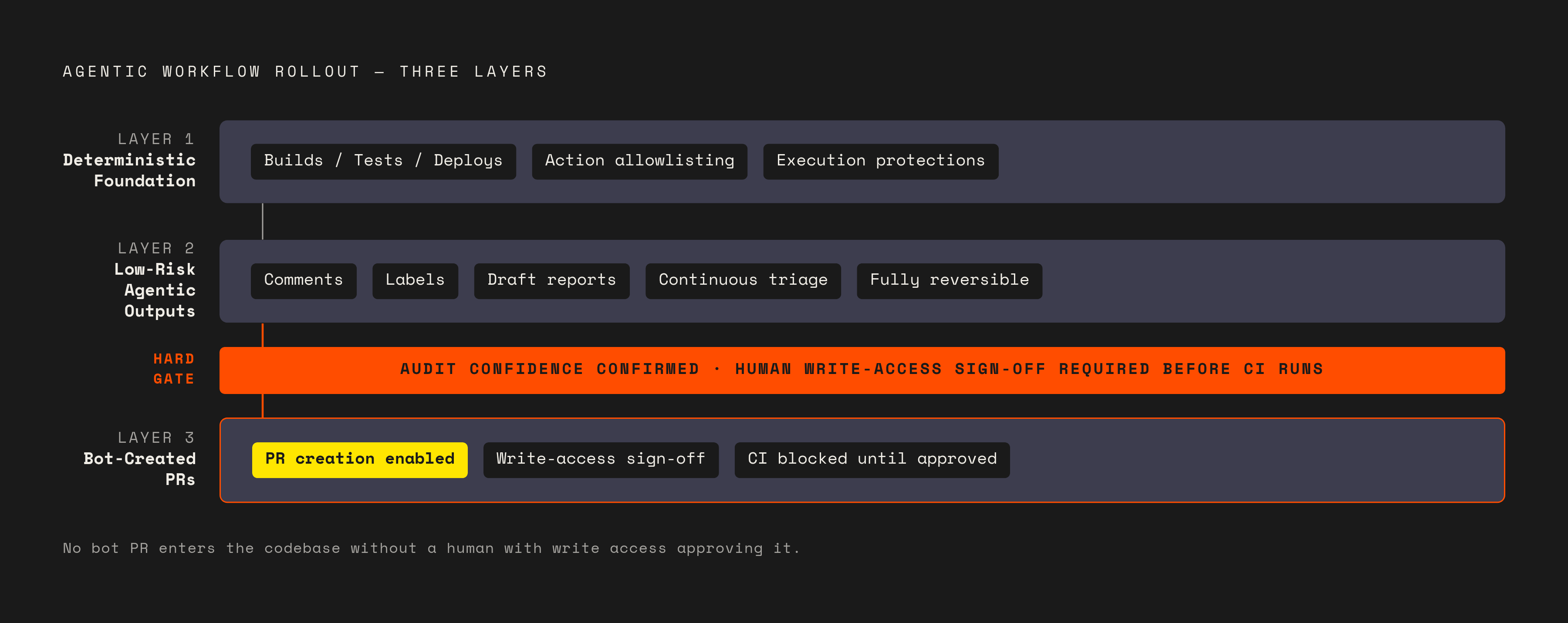
Layer one is the deterministic foundation; it needs to be solid before anything agentic touches it. Build, test, and deploy should already run cleanly on conventional Actions, with test coverage accounting for the added demand AI-generated code brings with it. Action allowlisting, now available on every plan tier, and workflow execution protections should both be configured before an agent is given any access to the pipeline.
Layer two starts small on purpose. Bring in agentic workflows whose only outputs are comments, labels, and draft reports, continuous triage and continuous reporting are the natural starting points, because they're reversible and easy to audit before any PR-creation capability gets turned on.
Layer three is where bot-created PRs enter the picture, and only once the team has enough confidence in agent output to trust it. Under the current approval model, every bot-created PR needs a user with write access to sign off before CI even runs, which keeps a human in the loop at the one point where code actually starts moving into the codebase.
Security has to run through all three layers, not as a separate step at the end. Apply the pull_request_target event policy well ahead of its November 2, 2026 enforcement date. Treat every piece of content an agent reads, issues, PR descriptions, comments, files, as a potential injection surface, because the incidents above show that's exactly where attackers are already looking. And pin action SHAs as a matter of course, not an afterthought bolted on once something goes wrong.