Authentication Implementation Risks in AI-Generated APIs
AI models consistently fail to implement secure authentication, leaving APIs exposed by default.

Every AI coding assistant gets trained and rewarded on one question: does the code run? Whether that code resists an attacker is a separate question, one the training loop never actually asks, and authentication logic absorbs the sharpest edge of that gap because broken auth still looks, on the surface, like working software. This is the defining security failure of the AI coding era, and it deserves to be treated as one.
A demo login screen with no session handling passes every functional test a developer throws at it. An API key sitting in plain view inside client-side code doesn't stop the app from loading. A database with no access restrictions still returns the query results the frontend expects. None of these are edge cases. They are the default output of a system trained to produce code that executes, not code that holds up against someone trying to break it. Authentication is uniquely exposed to this blind spot because, unlike a broken button or a failed render, missing auth logic throws no error. The model never gets a signal that something is wrong, so it never learns to fix what it can't see failing.
That doesn't mean AI-generated code is bad across the board. Syntax, boilerplate, and well-documented patterns appear thousands of times in public repositories, and these tools handle them well, often at the level of a competent junior developer. Security invariants sit in a different category. They require reasoning about what a malicious actor might attempt, not just what a legitimate user needs, and that kind of adversarial reasoning sits outside what next-token prediction was built to do. No amount of scale fixes that, because the objective function was never asking the question.
The scope and measurability of the authentication vulnerability gap in AI-generated code
Start with adoption, because it sets the stakes for everything downstream. JetBrains surveyed close to 25,000 developers and found 85% use AI coding tools regularly. Google has reported adoption north of 90% among software development professionals. These tools are the default way code gets written across the industry. They're the default way code gets written.
The volume backs that up. Organizations report that somewhere between 41% and 80% of their codebase is now AI-generated, and Cursor alone has reported crossing a billion lines of committed code. Cycode's State of Product Security in the AI Era 2026 report found every single organization surveyed confirmed AI-generated code somewhere in its systems, yet 81% admitted they lack full visibility into how or where that code enters the development lifecycle. Adoption has outrun oversight, by a wide margin, and that gap is the whole story in miniature.
The clearest picture of what it costs comes from Veracode's 2025 GenAI Code Security Report, the largest systematic study of its kind to date. Researchers tested more than 100 large language models across 80 coding tasks in four languages: Java, JavaScript, Python, and C#. AI-generated code carried several times more vulnerabilities than code written by humans. Forty-five percent of it failed secure coding benchmarks outright, and the industry-wide pass rate has been stuck at 55% with no real movement. Java fared worst, with a 72% failure rate on security benchmarks, while Python, C#, and JavaScript clustered between 38% and 45%. None of this improved as models got bigger or more sophisticated. Scale bought better syntax, not better security judgment. That is the finding the industry keeps trying to argue around instead of accepting.
The specific authentication patterns AI models consistently fail to implement correctly
ChatGPT, DeepSeek, Claude, Gemini, and Grok all fail in the same shape. Authentication mechanisms, session management, input validation, and HTTP security headers show critical gaps across every one of them, and not a single model fully aligns with established secure coding practices. Not one enforces a secure CORS policy by default, which is as close to a universal failure as this research gets.
Hardcoded credentials appear across every model tested. API keys get embedded directly in client-side code. Database connection strings get written straight into source files, in the open, where anyone with repository access, or worse, anyone who stumbles onto the repository, can read them. This maps onto two of the oldest, best-documented weakness categories in the field, and the models keep reproducing them anyway, generation after generation.
Token handling is where the failures turn specific, and dangerous. AI-generated token handling frequently omits checks on whether a JWT should be trusted, including validation of signing and algorithm strength. Expiration validation is commonly absent, leaving tokens active well past their intended lifetime. And in a mistake that occurs more often than it should, auth tokens get passed as part of a URL instead of a header or a secure cookie, exposing them in places where they can be read by unintended parties.
The effect of prompting behavior on authentication output
Prompting matters, but not in the way most teams assume. A Backslash Security study tested seven LLMs using "naive" prompts, the kind of plain, functional request most developers actually type when they want a feature built. Models consistently produced code vulnerable to several of the most common weakness categories tracked in the field.
Prompting explicitly for security did improve the output, and meaningfully. A developer has to know to ask for it, and has to ask every time, on every feature, for the rest of the project's life. That almost never happens in production workflows. Developers are shipping a feature, not running a mental checklist of weakness categories before they type a request, so the fix that exists in the research rarely occurs in practice.
The consequences compound from there. Research has found that developers using AI coding assistants can produce less secure code than developers working without one, while also reporting greater confidence in what they'd built, rating insecure code as safe. Documentation cannot close this gap because the problem lies in false confidence, not missing knowledge. It's a false sense of security built into the interaction itself, and it appears early: in one representative study, research has found that the substantial majority of student participants accepted insecure AI-generated code offered to them without flagging or correcting it.
Authentication failures in AI-generated APIs in production
Moltbook is as clean a case study as the industry has produced so far. Moltbook was built entirely through AI coding tools with no conventional development review process. Within 72 hours of launch, 1.5 million API authentication tokens and 35,000 email addresses were exposed. The vulnerability itself wasn't exotic. A standard code review would have caught the configuration gap without much effort. The reason no one caught it is the actual story: there was no review, because the application came together entirely through conversational prompts, with no human checkpoint anywhere in the process. That's the review vacuum vibe-coded software creates, and Moltbook shows what happens when that vacuum meets a public launch.
CVE-2025-48757, tied to Lovable and Supabase, tells a similar story at greater scale. The root cause: missing or insufficient Row Level Security policies in Lovable-generated projects. Scans of Lovable apps found a significant share with exposed databases spanning hundreds of vulnerable API endpoints. Attackers didn't need to steal or guess a credential to get in. The public anon_key embedded directly in the client code was enough to run direct queries against Supabase, pulling full user lists, payment records, or API keys without ever logging in. The vulnerability class isn't limited to Lovable, either. It extends to apps built with Bolt.new, Cursor, v0, Replit, and any custom development assisted by ChatGPT or Claude that generated Supabase schema migrations without configuring Row Level Security. This vulnerability class has emerged as one of the most prevalent critical findings in vibe-coded apps.
The Tea App leaked a large volume of private images and messages, the result of missing access controls rather than any sophisticated breach. Langflow's CVE-2025-3248 shows the same pattern applied to code execution instead of data exposure: versions prior to 1.3.0 shipped an unauthenticated API endpoint, /api/v1/validate/code, that let a remote attacker with no credentials send a crafted HTTP request and execute arbitrary code on the system. It carries a critical severity rating, about as severe as the scoring system allows.
The place of broken authentication in the current API threat landscape
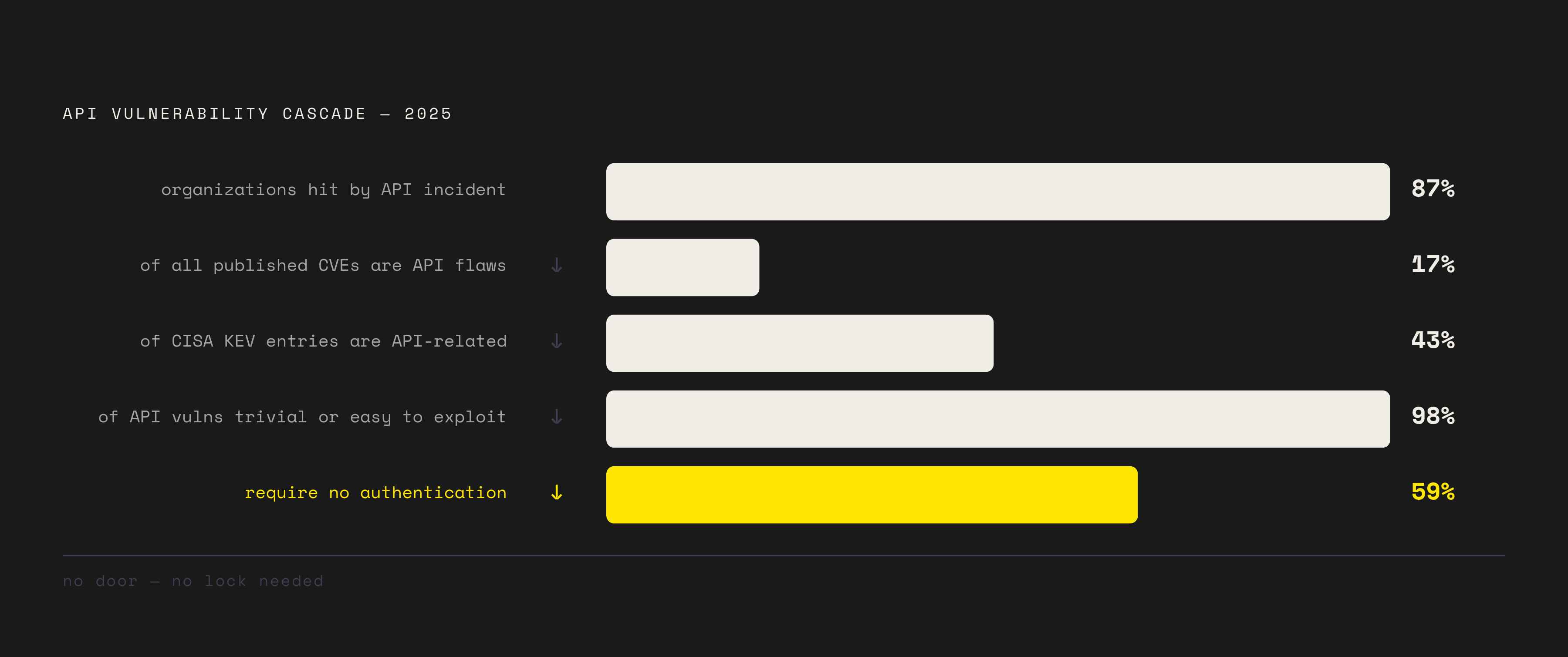
None of this happens in isolation. Akamai's State of the Internet report found that 87% of organizations experienced an API-related security incident in 2025, with API attacks striking organizations with growing frequency. APIs account for 17% of all published security vulnerabilities in 2025, making them one of the most significant attack surfaces tracked.
The exploitation data is where the authentication story sharpens. Of the vulnerabilities added to CISA's Known Exploited Vulnerabilities catalog, 43% were API-related. Of API vulnerabilities generally, 98% are classified as trivial or easy to exploit, and 59% require no authentication at all to pull off. That's the number that matters most in this whole piece: 59% require no authentication at all, meaning attackers are walking through a door the code never bothered to build rather than cracking anything. They're walking through a door the code never bothered to build.
The limits of runtime controls in closing the authentication gap AI introduces at the code level
BOLA, hardcoded credentials, broken authentication, overly permissive scopes: these all get written into the code during development, long before an API reaches a gateway or a firewall. By the time a runtime control has the chance to inspect traffic, the vulnerability has already shipped. Treating this as a perimeter problem is the mistake most security teams are still making: the gateway was never going to catch this, because the code was broken before it got there.
Gateway-level enforcement, JWT validation, API key checks, OAuth flow inspection, does real work in cases where broken authentication sits at the perimeter and the gateway is genuinely positioned to catch it. But AI-generated code routinely places the flaw inside handler logic instead, buried in application code the gateway never inspects at that depth. Lock the perimeter down perfectly and the vulnerability still gets through, because it was never a perimeter problem.
BOLA and missing object-level authorization are especially stubborn here. A malicious request asking for another user's data looks, at the traffic level, identical to a legitimate one. There's no signature to catch, no anomalous pattern to flag, because the only way to tell the two apart is knowing what that specific user is allowed to see, and that's context no amount of traffic analysis can reconstruct from outside the application.
Hardcoded credentials follow their own path of damage. Once a secret lands in source code, it doesn't stay put. It travels into version control history, into CI/CD logs, into container images, into whatever deployment artifact ships next. A runtime web application firewall sees none of that trail, because by the time traffic is flowing, the secret has already been copied into half a dozen places a perimeter tool was never built to look.
The placement of authentication controls when AI is writing the code
The controls have to move to where the code actually gets written, and they have to run on every commit, not just against the known APIs sitting in a gateway inventory. AI agents write endpoints faster than any human review process can keep pace with, and that speed produces shadow APIs: endpoints that exist in production and never appear in the inventory anyone is actually watching.
Static application security testing needs to be configured specifically to flag what functional tests structurally cannot see: missing object-level authorization checks buried in handler code, acceptance of unsigned tokens, absent expiration validation. Secrets detection has to run inside the developer's own workflow and inside the CI/CD pipeline, catching hardcoded credentials and connection strings before they enter version control at all, not after they've surfaced somewhere downstream in a deployed artifact. Software composition analysis rounds this out by catching authentication libraries running versions with known JWT vulnerabilities already documented against them.
None of this is a new category of security discipline. It's the same code-level rigor security teams have argued for since long before generative AI entered the picture. What's changed is the volume moving through the pipeline and the speed at which it arrives, and that shift is why the old argument, that controls belong in the code and not just at the gate, carries more weight now than it ever has.
Sources
- What Is API Security? Risks, Best Practices, and the Code-First Approach - Cycode
- AI-Generated Code Security Risks - Why Vulnerabilities Increase 2.74x and How to Prevent Them - SoftwareSeni
- Top 10 Application Security Predictions for 2026
- Why 53% of AI-Generated Code Ships with Vulnerabilities — AI Vyuh Code QA Blog
- ardura.consulting
- ox.security